
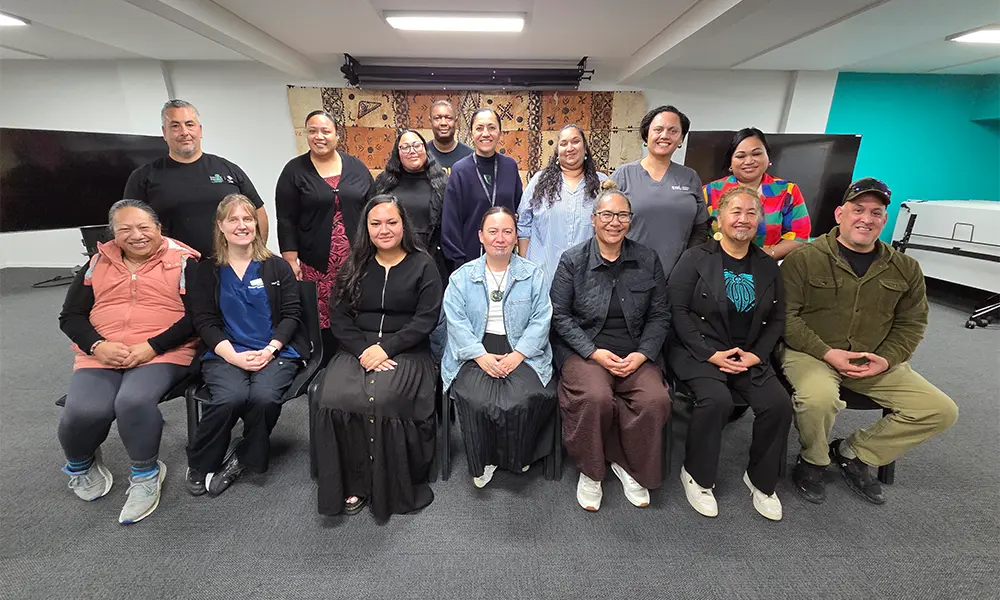
This month, Healthy Families | The Cause Collective brought together Māngere Health Centre, Rongoā practitioners from Te Rangiora Rongoā, and Papatūānuku Marae for the first time, laying the foundation for a new way of caring for whānau in South Auckland.
Some of the most important moments in systems change never show up on a dashboard. This month was one of them.
At its heart, He Oranga Hou, He Oranga Whakapapa is about type 2 diabetes, and the whānau living with it. Māori are more likely to develop type 2 diabetes, often at a younger age, and more likely to experience serious complications such as kidney disease, heart disease, vision loss and amputation. In South Auckland, these realities touch almost every whānau. But diabetes is never just about blood sugar. It is shaped by stress, income, housing, access to kai, and generations of disconnection from the knowledge and practices that once kept our people well. That is why this kaupapa brings clinical care and Rongoā together, so whānau can be supported across every dimension of their wellbeing.
Until now, Healthy Families had been working with each partner individually, organising how things would be managed from either end. This hui changed that. For the first time, the three partners at the heart of He Oranga Hou, He Oranga Whakapapa were welcomed together into and under the Healthy Families whare, with two clear purposes: to build relationships, and to map out a practical pathway for whānau from Māngere Health Centre to Te Rangiora Rongoā.
And rather than starting with the logistics, we started with each other. The hui was about whanaungatanga: meeting kanohi ki te kanohi, sharing who we are and where we come from, and building the trust every real partnership needs.
It was also a chance to understand each other’s worlds. Primary care and Rongoā stand on very different foundations. General practice works within appointment times, clinical protocols and funding structures. A Rongoā practitioner may begin with karakia and whakawhanaungatanga, taking time to understand the whole person and their whakapapa before any healing begins. Neither is wrong, but without understanding, those differences easily become barriers instead of strengths.
The most powerful moments came from simple, honest kōrero. Māngere Health Centre saw the care, intention and tikanga behind a Rongoā session. Rongoā practitioners gained insight into the pressures and realities of general practice. Both came away appreciating how the other makes their space safe and meaningful for whānau.
Māngere Health Centre’s nurse and health coach felt a deep connection to the kōrero. They sit every day in the space between clinical care and whānau lives, hearing the stories behind the symptoms: the stress, the financial pressure, the grief and disconnection. The Rongoā practitioners gave language to what they see, connecting health outcomes to a wider system of wellbeing where wairua, whenua, whānau and whakapapa all play a part. It was Te Whare Tapa Whā brought to life, not as a model on a wall, but as shared understanding growing in the room.
Papatūānuku Marae completes the picture. As champions of the Māngere community, the marae will open its doors to whānau who would rather have their Rongoā appointments in a community space than at the clinic. That choice matters. A clinic can feel formal; a marae offers a familiar place grounded in tikanga, where whānau feel at home. For many, that is the difference between showing up and staying away.
Why this matters
Lasting change for whānau doesn’t come from one-off programmes. It comes from shifting the systems that shape their lives: relationships, how organisations work together, where resources flow, and whose knowledge is valued.
He Oranga Hou, He Oranga Whakapapa sits within our wider Oranga Whakapapa strategy, building a Māori prevention system alongside mainstream health services. Not to replace clinical care, but to enrich it, so whānau receive care that honours their knowledge, relationships and dignity.
Relationships are one of the strongest leverage points in any system. When general practice understands why a Rongoā practitioner works the way they do, when practitioners understand the realities of primary care, and when a marae is recognised as a legitimate place of healing, the system begins to shift. Referrals become warmer, trust grows, and whānau move between different kinds of care instead of falling through the gaps.
It is also about mana, which we believe is held collectively. Māngere Health Centre’s clinical expertise is valued. Rongoā practitioners are recognised as experts and genuine system partners, not an add-on. The marae is honoured for its place in the community. When the mana of every partner is lifted, whānau benefit most.
“No matter what is happening in our state of being, we not only have the right but the ability to take ourselves to holistic wellbeing, hauora on all levels.”
-Manu Suganuma, Kanaka Maoli Rongoā Practitioner
What’s next
With these relationships in place and a shared pathway now mapped out, the mahi is already underway. Māngere Health Centre has begun booking whānau living with type 2 diabetes in to see their health coach, who will record each person’s baseline HbA1c level. HbA1c is a simple blood test that shows a person’s average blood sugar levels over the past two to three months, giving a clearer picture of how well diabetes is being managed than a single day’s reading.
From there, whānau will continue their journey with a Rongoā practitioner from Te Rangiora Rongoā, at the clinic or at Papatūānuku Marae, whichever feels right for them, supported by the Oranga Hou Wellness Kit. These sessions go beyond the numbers. Rongoā offers whānau the space to explore what sits beneath their diabetes, the stresses, burdens and unseen challenges that clinical care alone can’t always reach, and to reconnect with a view of wellbeing that embraces tinana, hinengaro, wairua and whānau as one. The aim is not simply to manage a condition, but to walk alongside whānau as they reclaim the knowledge and strength to care for their whole selves.
HbA1c levels will be checked again at three and six months, and alongside feedback from whānau, practitioners and clinical staff, this will help us learn what works, what needs to change, and what truly integrated whānau wellbeing can look like.