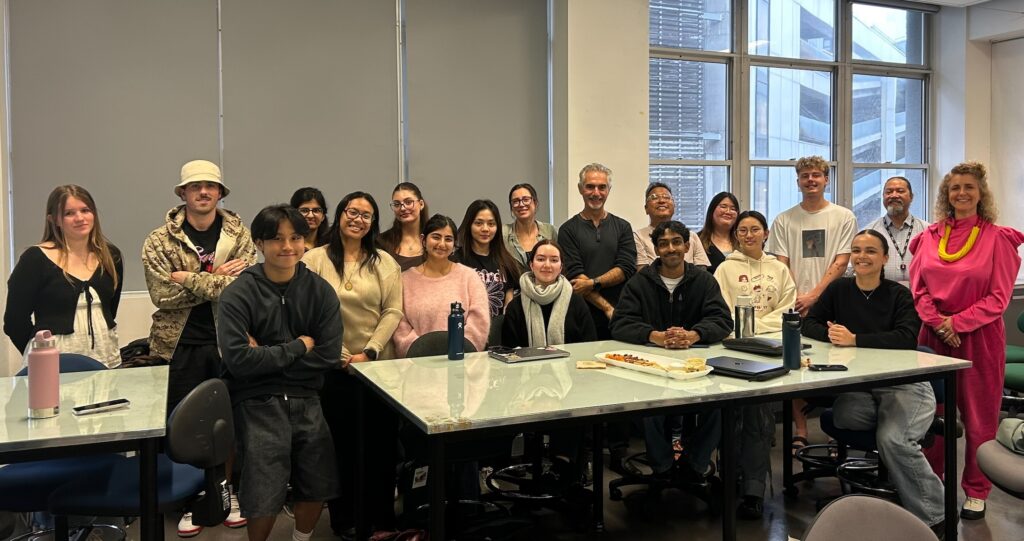
With the Healthy Families South Auckland and AUT partnership reaching a decade milestone in 2026, Lead Systems Innovator Julio Bin and Senior Lecturer Lisa McEwan reflect on a successful 2025 programme, why this partnership is important and what opportunities lie ahead.
2025 highlights and the Good Food Journal project
As Healthy Families South Auckland (HFSA) and Auckland University of Technology’s Design for Sustainability programme enter their tenth year of partnership, the collaboration stands as a powerful example of what long‑term, community centred innovation can achieve. Over a decade, the partnership has consistently transformed real world challenges into meaningful learning experiences, tangible prototypes, and pathways that strengthen community wellbeing, laying the foundation for a milestone year worth celebrating.
The 2025 cohort brought fresh energy, deeper systems understanding, and, for the first time, a student project selected by HFSA for funded development: The Good Food Journal(GFJ). The project will move into prototyping with seed funding earmarked for development and school trials in 2026; students are already engaged in next-stage work.
The Good Food Journal video essay.
What happened in 2025: learning, impact and outcomes
The 2025 Applied Sustainable Design Project continued to follow the course brief’s systems change structure, problem definition, design response and design communication, and used the Good Food Road Map and the Six Conditions of Systems Change as core frameworks. This approach intentionally grounded student work in place-based, participatory, and implementable action plans.
Students followed iterative design processes learnt over the previous two years, however, adding the Six Conditions of Systems Change model to their practice added a new rewarding dynamic. It required them to interrogate factors such as mental models, power dynamics and resource flows, and to analyse how these aspects might present in the given scenario they had chosen to address.
Students produced action plans, prototypes and communication strategies that responded to specific community settings, university campuses, schools and neighbourhood hubs, with tangible pathways for trial and scale.
Most importantly, the Good Food Journal student project, a classroom kit designed to build children’s relationship with kai and local food systems, was chosen by HFSA for further development. The GFJ’s intent to “promote positive food practices that better the health and wellbeing of our tāmariki” and to build on mātauranga Māori principles is already shaping a funded prototype phase for 2026.
Voices from the course
Jennifer Whitty, teaching the course in 2025 felt that working with the Good Food Road Map and Six Conditions of Systems Change model enhanced the student experience and outcomes, noting the focus on holistic system framing.
She also reflected candidly on how the course changed her own practice: “I too realised I had overlooked important systemic factors, such as power dynamics and the flow of resources.”
Students echoed this. One commented that the Good Food Road Map “was crucial for our design process… it gave us a clearer understanding of what the problems were and what the ideal food system could look like”. Another student described the value of the Six Conditions: tools like these “helped me see more of the interplay between various factors that impact systemic issues and helped my group come up with a more impactful design solution”.
Julio Bin, who co-designed the course brief, facilitated sessions, and authored the Good Food Road Map framework, reflected on the partnership: “It’s been incredible to watch students engage with systems thinking and evolve their understanding of food systems. Seeing a student project like the Good Food Journal move from classroom to funded prototype shows the power of sustained collaboration.”
Why this partnership matters to AUT and Healthy Families South Auckland
The partnership creates value well beyond student learning. It provides a practical way to support young people to develop strong critical and systems-thinking capabilities while also strengthening and evolving HFSA’s own mahi. By using the Good Food Road Map and the Six Conditions of Systems Change as core teaching frameworks, HFSA can test these tools in real time, seeing how they are understood, interpreted, challenged and applied by emerging practitioners.
This feedback loop helps refine and improve the frameworks themselves. The partnership also enables HFSA to introduce students directly to ongoing community initiatives, grounding academic learning in lived realities. The impact is both direct and indirect: students contribute ideas and prototypes that can be implemented in communities, while longer-term benefits include a growing workforce equipped to design for prevention, equity and wellbeing. Collectively, this strengthens community capability, supports positive food relationships, and contributes to better mental health and wellbeing through connection, agency and participation.
Lisa McEwan, who has led the Design for Sustainability minor at AUT since its inception in 2014, speaks highly of the collaboration with HFSA and the impact it has had on student growth.
“The live projects that we have run with HFSA are pivotal in student learning as they near the end of their degree. While the projects are underpinned with academic knowledge, the opportunity to work with external partners from Auckland Council and community groups across Tāmaki Makaurau provide authentic experiences that bridge the gap between theoretical understandings and real-world applications. The collaboration not only supports progression in the student work, but it also impacts them as emerging professionals, providing insights into career opportunities within the social innovation and design for sustainability spaces.”
For academia and students, the partnership provides authentic, high stakes learning where students test methods (systems mapping, transition design, and participatory design with industry and community stakeholders) and produce outputs that matter beyond grades. Many students signalled intent to carry systems thinking into internships and careers.
And for our communities,projects such as the Good Food Journal and other from previous cohorts are practice-ready ideas that centre community ownership, cultural relevance and local resource flows, increasing the likelihood of sustainable uptake.
The course explicitly aligns with HFNZ’s prevention mandate: it develops place-based strategies to make “good food the best and easiest choice”, connecting education, supply, resource flows and community practice. The projects created by students usually target behaviours and mental models about food, which are key levers to longer-term improvements in diet-related health and wellbeing.
Lessons and opportunities for replication
Several key lessons have emerged from this partnership that could be applied across other universities and Healthy Families sites in Aotearoa. First, working with real partners and real briefs is critical. The involvement of HFSA brings legitimacy, practical constraints and lived context into the classroom, helping students move beyond theoretical design and towards implementable solutions. Students consistently reported that engaging with real-world food system challenges, and receiving feedback from practitioners, made their learning more meaningful and impactful.
Second, combining systems thinking with Te Ao Māori perspective is essential. Integrating cultural, social, economic and environmental worldviews strengthens students’ understanding of systems and ensures that proposed solutions are grounded in place, relationships and indigenous knowledge.
Another key learning is the importance of creating clear pathways from student prototypes to real-world pilots. HFSA’s decision to allocate seed funding to the Good Food Journal project demonstrates how promising student ideas can be supported beyond the classroom, accelerating innovation while maintaining community relevance and integrity.
What’s next
The partnership continues into 2026 with another course starting in February. The GFJ is in prototype development and plans to deepen implementation pathways with school partners. The ongoing collaboration remains a compelling model for other organisations and universities to replicate, a low cost, high impact way to surface community-rooted solutions, develop future practitioners, and accelerate prevention-focused outcomes.
In Julio Bin’s words: “Collaboration is at the heart of what we do. By bringing together students, lecturers and community partners, we’re turning ideas into action, and that’s where real health and wellbeing gains begin.”